Focus Frames: Building Healthier Phone Habits Through Intentional Design
Client: Focus Frames
Challenge
Smartphones are designed for distraction with endless notifications and app-hopping. Users needed a simple, non-intrusive way to build healthier phone habits without complex setups or blanket restrictions—just intentional, mindful phone use.
Solution
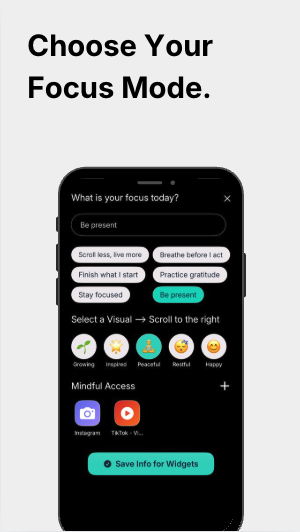
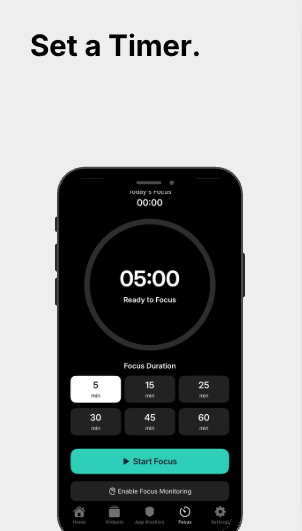
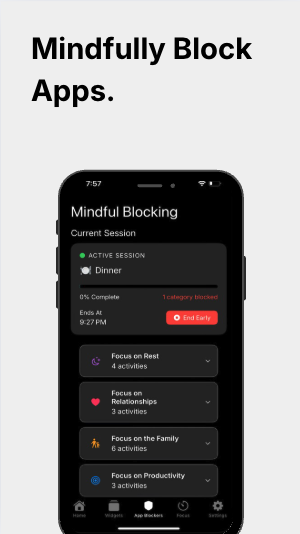
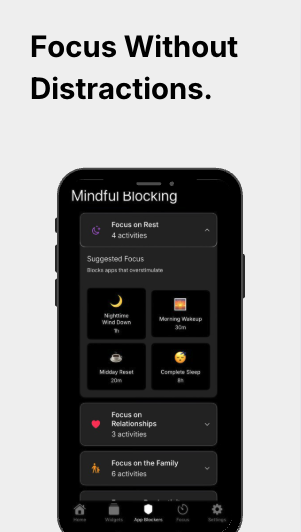
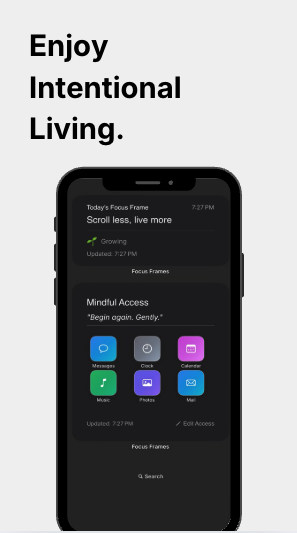
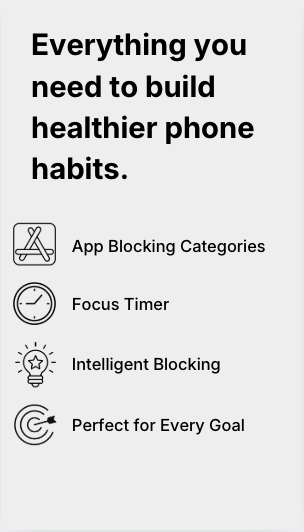
Developed an iOS app using an MVP-first approach that gently interrupts autopilot phone unlocking, prompting users to choose a focus intention and commit to distraction-free sessions with app blocking and focus timers.
Timeline
6 weeks
Project Gallery

Technologies Used
Key Results
- Successfully launched on iOS App Store
- MVP shipped in weeks, not months
- Built custom reusable subscription SDK
- Subscription model: $4.99/month recurring revenue
- Positioned across multiple user segments
- Clean, minimal UI emphasizing mindfulness
- Foundation for white-label opportunities
Overview
Focus Frames is an iOS app that helps users build healthier phone habits by combining app-blocking and focus timers. Each time a user unlocks their phone, the app gently interrupts autopilot, asking them to choose an intention (e.g., "Work focus," "Family time," or "Night rest") and commit to a distraction-free session. As a result, the user's home screen becomes less of a gateway to doomscrolling and more of an intentional launch—helping reclaim time, reduce digital clutter, and support mindful, intentional living.
Focus Frames was developed and shipped by HatchByte Studios using a lean, MVP-first approach, and includes a custom subscription SDK that HatchByte's clients can leverage for their own subscription-based mobile apps.
The Problem & Market Opportunity
The Core Challenge
Smartphones and their ecosystems are designed for distraction: endless notifications, app-hopping, social media, news feeds, etc. This "always-on" design often undermines productivity, deep work, family time, rest, and general mental well-being. Focus Frames identifies this as a core pain point.
Market Gap
While digital-wellness and "phone detox" trends have gained popularity, many existing solutions are either overly complex, too general, or require substantial friction (e.g., full phone-level restrictions, parental control-style setups). There was room for a simpler, user-friendly app tailored to people who want flexibility (not blanket bans), and intention rather than control.
Thus, Focus Frames sought to meet a real user need: a minimalist but effective way to interrupt smartphone autopilot and give users control over when and how they use their device.
Approach: MVP-First Development
Rather than building an all-encompassing digital-wellness giant from day one, HatchByte Studios opted for a Minimum Viable Product (MVP) approach—focusing on delivering the core value quickly, validating assumptions with real users, and then iterating from there.
MVP Strategy & Rationale
Core Value First
Focus Frames in its first version shipped with only the essential features: a calm, minimal UI; the ability to choose a focus mode (work, family, rest); set a timer; and block distracting apps for the duration. This aligns with best practices for MVPs: delivering only what is necessary to test the value proposition, avoid over-engineering, and reduce time-to-market.
Lean Resources, Rapid Release
By limiting scope, HatchByte minimized development time and resource usage, while releasing a functional, polished product to real users—not a rough prototype, but a usable app. This approach enabled real-world feedback early on, accelerating learning and reducing risk.
Focus on User Experience and Clarity
The app design emphasizes simplicity, calmness, and intentionality—elements that reinforce its value proposition around mindfulness and controlled phone use. The choice to avoid cluttered features or overcomplicated flows reflects good MVP design thinking.
Why MVP Worked for Focus Frames
- The MVP allowed HatchByte to validate demand: whether users would pay for—or even use—a focus/phone-blocking tool in everyday life
- It reduced upfront investment and time to launch, enabling a faster go-to-market
- It created a foundation for future iterations, additional features, and scaling only once core user value was proven
In short: Focus Frames didn't try to be everything to everyone at launch—it focused on solving a specific, real problem for a clear user segment.
Subscription Model & Custom SDK: Strategic Edge
An important strategic component behind Focus Frames was the inclusion of a custom subscription SDK—developed by HatchByte Studios—used to manage in-app subscriptions. Focus Frames is free to download but requires a $4.99/month subscription to access all content and features.
This subscription SDK offers two key advantages:
Recurring Revenue Stream
By using a subscription model from launch, HatchByte ensures recurring monetization rather than relying on one-time purchases or ads. For a digital-wellness tool that aims to be used repeatedly over time, subscription makes sense—helping align user incentives around long-term habit change.
Reusability for Other Clients
Because the SDK is custom-built by HatchByte, it becomes a reusable asset: other HatchByte clients building subscription-based mobile apps can adopt the same SDK rather than building subscription flows from scratch. This not only saves development time and cost for new clients—but also establishes a productized, scalable offering for HatchByte.
Thus, the combination of MVP-first development + a reusable subscription SDK creates a business and technical framework where Focus Frames is both a standalone product and a proof-of-concept/reference implementation for potential clients.
Early Results & Product Positioning
As of its release in 2025:
- Focus Frames is listed on the iOS App Store, under Productivity, developed by HatchByte Studios LLC
- The app's marketing—via getfocusframes.com—frames it as a "mindful launcher" helping users transform their phone experience: from chaotic and distracting → to clean, intentional, and focused
- Target audiences include digital-wellness seekers, professionals looking to protect deep work, parents who want to model healthy habits, students, and people wanting better rest or quality time—giving Focus Frames a broad but coherent positioning
This broad positioning gives the app flexibility to grow across different user segments—from productivity-focused individuals to people seeking mental wellness and better phone-life balance.
"Focus Frames represents the power of starting lean and focused. By building an MVP first, we validated real user needs quickly and created a foundation that serves both our product goals and our clients' future needs through the reusable subscription SDK."
— Mike Zevitas, Founder of HatchByte Studios
What's Next: Potential Growth & Feature Expansion
Because Focus Frames started with the core essentials, it leaves room to iterate, test new features, and expand based on real user feedback and usage data. Some opportunities for next-phase development include:
Granular User Analytics & Personalization
Track user patterns (when they use focus mode, for how long, which apps they block), then suggest personalized "focus sessions," or surface insights (e.g., how many hours of distraction avoided, how many focus sessions per week).
Customizable Focus Modes / User-Defined Categories
Beyond the built-in "Work, Family, Rest," allow users to create their own categories (e.g., "Creative time," "Reading," "Exercise break").
Cross-Device Syncing / Multi-Device Support
Perhaps extend beyond iPhone to iPad, or integrate with desktop tools to offer a broader "digital wellness ecosystem."
Social or Community Features
Support shared focus sessions, streaks, or group "focus hours" (e.g., study groups, family device-free time), increasing user engagement and retention.
Longer-Term Habit Tracking & Coaching Features
Reminders, journaling prompts, periodic summaries of phone usage vs. focus time, to help users build sustained healthy habits.
White-Label Version Using the Subscription SDK
Offer Focus Frames as a white-label product or a base template to other clients (via HatchByte Studios) who want to launch their own subscription-based focus or wellness apps quickly.
Key Learnings: Lessons from the Focus Frames Build
From the Focus Frames project, several broader lessons emerge—many consistent with best practices for MVP-based app development:
Lean + Value-Focused Beats Overbuilt
Trying to launch a fully featured "do-everything" wellness or productivity app from day one often results in delays, wasted resources, and misalignment with real user needs. Starting minimal and focused helps validate the core value first.
Reusability at the SDK Level Pays Dividends
By building a custom subscription SDK, HatchByte transformed a one-off requirement into a reusable asset—a smart move for agency or studio-based business models.
Positioning Matters — Clarity + Empathy
The app's positioning around "intentional phone use," "mindful unlocking," and reclaiming time resonates with real pain points for many people (distraction, doomscrolling, work-life balance).
Flexibility Enables Growth
The MVP leaves room for iteration—whether feature expansion, deeper user insights, or new user segments. This keeps the product adaptable and user-driven.
Conclusion
Focus Frames is a strong example of what's possible when you combine a clear problem statement ("phones distract us"), a focused solution ("block distracting apps + timers + intention"), and a lean, MVP-first development + business approach (subscription + reusable SDK).
By starting small and intentional, Focus Frames validated its core value quickly, opened doors for future growth, and built a reusable foundation for both product and agency-side success.
Ready to build your next mobile app with an MVP-first approach? Let's discuss how we can help you ship faster and smarter.
Ready to Start Your Project?
Let's discuss how we can help you achieve similar results. Every great product starts with a conversation.
Get Started Today